06/02/2012

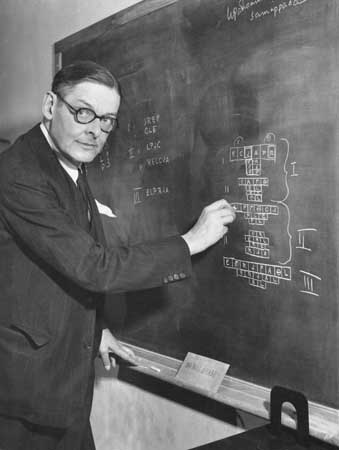
Eliot in Murderland


A rare fixed point in an ever-changing universe, every new issue of CADS is brimming with great stuff, and Number 62 makes no exception. Among the highlights is Curtis Evans's typically well-researched and insightful piece on T.S. Eliot's mystery criticism. Yes, that T.S. Eliot.

The fondness of the author of The Waste Land for detective stories is not exactly news. His enthusiastic endorsement of The Moonstone has graced many editions of the book. Neither is it very surprising. Detective stories were always popular with modernist writers from Bertolt Brecht and William Faulkner to Jorge Luis Borges and Gertrude Stein. Opposition mostly came (and still comes) from more conservative-minded people for whom the nineteenth century novel remained the impassable horizon of literature. What's really surprising, and extremely interesting, is the kind of detective fiction that appealed most to the future Nobel laureate.

While his defence of The Moonstone might lead one to believe Eliot favored those detective writers who aimed at literary significance, he was actually quite fond of "pure" puzzles, extolling the works of Agatha Christie, R. Austin Freeman, S.S. Van Dine and the "humdrums" J.J. Connington and Freeman Wills Crofts. So passionate was he about what John Dickson Carr would later call "The Grandest Game in the World" that he even deviced a set of rules for "good" detective fiction, predating those by Knox and Van Dine by some years. Authors who tried to "push the envelope" seem not to have been his cup of tea as his notable silence on Sayers suggest. This is not to say that Eliot didn't care at all for the "human element" but he realized that the combination of strong characterization and intricate plotting was a heavy task and a choice sometimes had to be made:

"Without dispraise of any individual writer we may be allowed to complain that modern detective fiction in general is weak in that it fails between two possible tasks. . . . It has neither the austerity, the pure intellectual pleasure of Poe's "Marie Roget", nor has it the fulness and abundance of life of Wilkie Collins. We often wish that the majority of our detective writers would concentrate on the detective interest, or take more trouble and space over the characters as human beings and the atmosphere in which they live."

Indeed.

If this made you want for more, I strongly suggest you ask for your copy of CADS to 9 Vicarage Hill, South Benfleet, Essex, SS7 1PA, United Kingdom. You won't be disappointed.

05/02/2012

Good Lieutenant


It's sale season in France and I seized the occasion to finally acquire the complete Columbo series at a bargain price. The series was one of my first introductions to the mystery genre and remains a personal favorite despite, or thanks to, multiple viewings. What fascinates me most is how the show stayed fresh for most of its course while essentially telling the same story over and over again; only L&O in its prime managed the same feat. Formulaic it was, but intelligently so: modern executives take notice!

Also it was and remains quite an achievement to make an iconic figure out of a character about whom so little is actually known. His first name remains shrouded into mystery. He is the only source for information on his personal and family background and we can never be 100% sure whether what he says is true. For instance he incessantly talks about his wife but she never appears on screen, and it's unclear whether they have kids; the only member of his family we ever meet is... his dog.

The most puzzling thing about Lieutenant Columbo, however, is his forever "underdog" status. How can a detective who tackles - and solves! - only high-profile cases remain such an obscure figure? In the course of his career Columbo sent senators, country singers, film stars, secret agents and the likes to jail and yet no one seems ever to have heard about his exploits - suspects keep taking him for a bumbling fool despite abundant past evidence that he isn't. Rather implausible, but then implausibility often makes for great fiction as any mystery fan knows - and Columbo brilliantly testifies to that.

29/01/2012

The Problem With "The Final Problem"


While one of the pivotal tales in the Canon - Sherlock Holmes dies! - The Final Problem is also one of the weakest. Despite its misleading title, this is not a detective story at all and the plot upon close examination makes little sense. Moriarty in particular is little more than a deus ex machina which Doyle conveniently pulls out of his hat so as to cause Sherlock's death; that he came to become one of the most famous characters in the Holmesverse is thus extremely ironical.

Of course these weaknesses may be explained away by the simple fact that Doyle was looking for the easiest way to get rid of a cumbersome character but even as a hatchet job The Final Problem is rather feeble; by no producing a corpse it leaves the door open to a possible "resurrection". Which leads us to the Big Question: Did Doyle really want to kill his creature? He could have settled the matter once and for all by giving him a proper "burial"; Holmes certainly would have had difficulties rising of the dead had his body been found and taken to the grave. Agatha Christie did this with Poirot and it's certainly one of the reasons why we don't see pastiches and continuations popping up on the shelves.

Doubts are furthered by the way Holmes was ultimately "revived". He had first returned with The Hound of the Baskervilles which Doyle stressed was set prior to the detective's "death". This approach was a sensible one and Doyle might have kept up with it; it was certainly simpler and more "realistic" than asking readers to believe Holmes had survived and spent years in hiding across the world before reappearing in a somewhat melodramatic fashion. So why did Doyle choose this latter option? And why does this "resurrection" fit so well with the events in The Final Problem, looking like their logical outcome rather than a later, recalcitrant change of heart? Is it possible Doyle knew all along that Holmes might be back someday?

22/01/2012

The P-word


Like it or not, mystery fiction is a very plot-driven genre. This is not to say that plot trumps everything - characterization, writing, setting have their importance as well - but plotting is more crucial to mystery fiction than it is to, say, sci-fi or western; one might even say that it is a defining feature of it. How comes then that modern critics tend to focus on a mystery novel's literary virtues, while either downplaying or ignoring outright plot?

An obvious answer is that many contemporary mysteries tend to be stronger in the literary department than the plotting one, not necessarily because their authors are weak plotters but simply because their interests are elsewhere. And yet "literary" mysteries with strong plots get the same treatment. A good example is Thomas H. Cook who is regularly (and rightly) praised for the elegance of his prose and the depth and richness of his characterization but almost never for his plots even though he is arguably the finest plotter in American crime fiction since Margaret Millar (with whom he has a lot in common, but I'll leave that for another post) I do agree with critics that Instruments of the Night or Red Leaves are fascinating studies in character and tragedy, but they're also masterful exercises in bamboozling and their final twists are central to the books' effects.

One of the mistakes that dragged so much of "literary" fiction into the pit of irrelevance and self-indulgence was to discard plot as unimportant. It is thus worrying to see mystery critics follow in the same trap. A good plot, as any serious mystery buff knows, is a hard thing to find - and it should be celebrated rather than swept under the rug. The P-word is not a dirty word.


Archives du blog